Why Landscaping and Pool Construction Must Be Planned Together
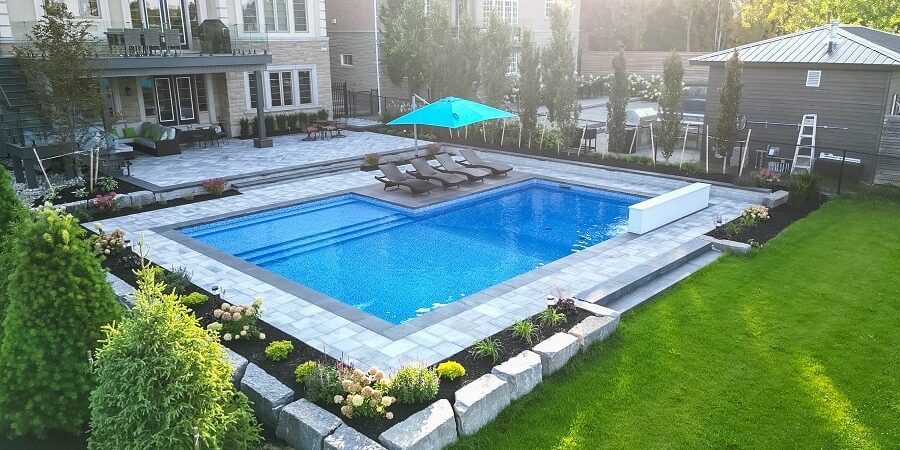
Many homeowners look at the pool and garden as separate entities. First, build the pool. Then, plan the landscaping around it. While that may sound sensible, it often leads to a budget crunch.
The Machinery Access Trap
Digging a pool requires big machinery. Excavators, concrete trucks, and delivery vehicles need to be able to roll in and out of your backyard unimpeded. When you do all your landscaping after pool construction, you’ll find that the access path has likely been destroyed by the pool project.
Here’s what happens: pour the pool, fence off the backyard, plant your beautiful garden, and then you decide the retaining wall at the back of your property needs a complete overhaul or you want to add a mature tree. Access is now blocked by your lovely new garden. So, in comes the bobcat to destroy the paved area that leads to your backyard.
Doing both projects at the same time allows you to intelligently sequence that machinery access: you’ll know what areas to keep empty until the last possible moment, and which can be used and almost finished early without compromising your other design.
Slopes Require Integrated Structural Planning
Sloped properties are where the cost of treating pool and landscape as separate jobs shows up fastest. A pool shell on a sloping block isn’t just a hole in the ground, it’s an engineered structure. The soil creates lateral pressure against the pool shell, and retaining walls are part of what manages that pressure.
If the retaining walls are engineered separately from the pool shell, there’s no guarantee the load-bearing calculations account for both structures together. Over time, soil movement against an inadequately supported pool wall can cause cracking. Rebuilding the pool or the wall after the backyard is finished is a very expensive exercise.
Getting pool builders sydney in early means that the pool engineering and the landscape engineering can be designed as one problem, not two, and that’s the only way to get it right.
Drainage and Grading Aren’t Optional Details
Managing water is the most complicated part of any backyard renovation. When you install a pool, or regrade for new lawn, or lay paving, or build garden beds, you change how and where water flows over your property.
If these elements aren’t considered cohesively, their drainage systems can work at cross purposes. Your pool’s overflow might direct water one way. Rain that falls on the new paving may direct water another way. If neither source of water drains properly, and isn’t correctly graded to a drain, you have waterlogged soil around the pool shell. Waterlogged soil causes the concrete to wick, which causes it to shift.
In the best designs, there is no “pool drain” and “yard drain”. There is water management, and everything, the grading, the drain points, the surface materials, is all in service of that.
Council Approvals Work Better With a Complete Plan
Having your pool and landscaping plans drawn up together will save you time and money. It’s cheaper and faster to submit all your plans in one bunch, and in most cases you will have the landscaping in place so you can make the most of your pool as soon as possible.
Finally, a seamless design and build process delivers an infinitely better result. Boundary lines aren’t compromised by poorly integrated structures, the pool drains properly (critical with freeform designs), your family’s safety isn’t compromised by pools that are too deep, the neighbors won’t be upset because their yard floods when it rains. The list goes on.
Infrastructure That Gets Buried Once
You need a conduit for garden lighting, gas lines for heating, and plumbing for irrigation, and all of it needs to go under the hardscaping. Once the paving is down, accessing any of it means cutting through what you’ve already paid for.
Pre-map utilities across both the pool and landscape design before a single paver is laid, and every line goes in during the excavation phase when the ground is already open. It’s not glamorous planning, but it’s the difference between a backyard that functions properly and one that requires disruptive work every time something needs changing.
The same logic applies to pool coping, the capping stone that edges the pool must transition cleanly into the surrounding paving. If the two are designed independently, you often end up with level or material mismatches that are visible, structurally awkward, and expensive to fix retrospectively.
What Integration Actually Costs You
SPASA industry benchmarks show that retrofitting landscaping, rectifying drainage issues, and repairing yard damage as a result of post pool machinery access can blow overall backyard renovation budgets by 15% to 20%. That’s a substantial sum on a mid-range project for issues that could have been eliminated at the planning phase.
The homeowners who don’t face these costs aren’t lucky, they’re the ones who sat around a table with both a pool builder and a landscape designer before any plans were finalised. The chat doesn’t cost a cent. The rework does.